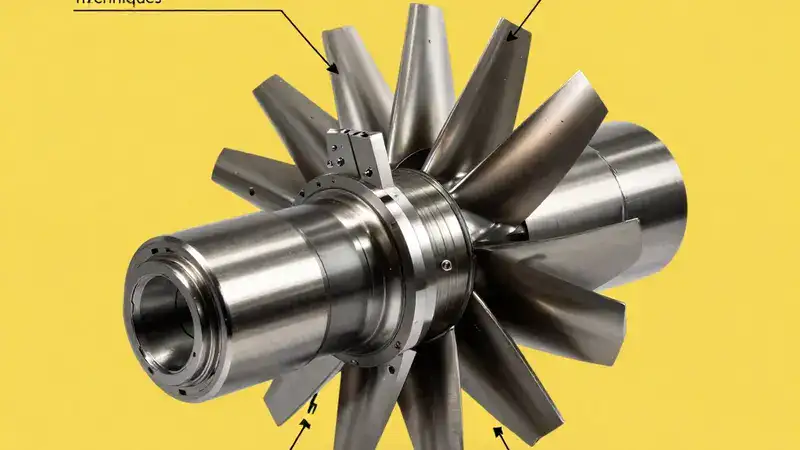
The aerospace industry operates at the cutting edge of engineering. Manufacturing aircraft parts requires extreme precision, superior materials, and processes that guarantee safety and performance under incredible stress. From the landing gear that supports a multi-ton aircraft to the intricate turbine blades in a jet engine, every component must be flawless.
Achieving this level of quality isn’t possible with traditional manufacturing alone. Instead, aerospace relies on advanced machining methods that push the boundaries of what’s possible. These technologies allow for the creation of complex geometries from high-strength, lightweight alloys that are notoriously difficult to work with.
This guide will explore the key advanced machining methods used to produce critical aircraft parts. We will cover the principles behind each technique, their specific applications in aerospace, and why they are essential for building the safe and efficient aircraft we depend on.
What is Advanced Machining?
Advanced machining refers to a group of sophisticated manufacturing processes that go beyond conventional cutting, turning, and milling. These methods often use thermal, electrical, or chemical energy to shape materials with exceptional accuracy. They are particularly vital for working with the superalloys, composites, and titanium that are common in aerospac. Due to their high strength-to-weight ratios and resistance to extreme temperatures.
These techniques enable manufacturers to produce parts with complex shapes, fine details, and superior surface finishes all of which are critical for aerodynamic efficiency and structural integrity.
Key Machining Methods in Aerospace
Several advanced techniques have become standard in aerospace manufacturing. Each offers unique advantages for specific applications and materials.
Computer Numerical Control (CNC) Machining
While CNC machining has been around for decades, its continuous evolution keeps it at the forefront of manufacturing. CNC machines use computer programs to control the movement of cutting tools with incredible precision. Multi-axis CNC machines, such as 5-axis mills, can create highly complex shapes in a single setup.
- How it Works: A digital design (CAD model) is converted into a set of instructions (G-code) that directs the machine’s tools. The machine automatically cuts, drills, and shapes the workpiece to the exact specifications of the design.
- Aerospace Applications: CNC machining is used for a vast range of components, including structural parts like wing spars and fuselage frames, as well as smaller, intricate components for engine and control systems. Its ability to produce identical parts repeatedly makes it ideal for series production.
Electrical Discharge Machining (EDM)
Electrical Discharge Machining, or EDM, is a non-contact process that uses electrical sparks to erode material. It is perfect for creating complex shapes in hard metals like titanium and Inconel, which are difficult to cut with traditional tools.
- How it Works: An electrode and the workpiece are submerged in a dielectric fluid. A high-frequency electrical discharge is created between the two, generating intense heat that melts and vaporizes microscopic particles of the material. The fluid then flushes away the debris.
- Aerospace Applications: EDM is essential for producing turbine blades with complex cooling channels, creating intricate molds for composite parts, and drilling fine holes in fuel injector nozzles. Its ability to work on hardened materials without inducing stress makes it invaluable.
Laser Beam Machining (LBM)
Laser Beam Machining uses a highly focused, high-energy laser to melt, vaporize, or ablate material. It’s a fast and flexible process that can be used for cutting, drilling, and engraving a wide variety of materials, including metals, composites, and ceramics.
- How it Works: A laser beam is directed at the workpiece, and its intense energy is focused on a tiny spot. This energy removes material with high precision and minimal heat distortion in the surrounding area.
- Aerospace Applications: LBM is frequently used for drilling thousands of tiny cooling holes in turbine engine components, cutting complex patterns in composite panels, and marking parts with permanent identification codes.
Electrochemical Machining (ECM)
Electrochemical Machining is another non-contact method that removes material using an electrolytic process. It’s essentially the opposite of electroplating. ECM is capable of machining very hard materials without creating thermal or mechanical stress.
- How it Works: The workpiece (anode) and a shaped tool (cathode) are placed in an electrolyte solution. An electrical current is passed between them, causing material from the workpiece to dissolve into the electrolyte.
- Aerospace Applications: ECM is used for shaping turbine blades, machining complex contours, and producing parts where a stress-free surface is critical. The process of aerospace deep hole boring can also leverage ECM principles to create precise, smooth internal channels in components like hydraulic cylinders.
Pushing the Boundaries of Flight
The evolution of aircraft design is directly linked to advancements in manufacturing technology. Methods like multi-axis CNC machining, EDM, and LBM are not just alternatives to conventional processes. They are enabling technologies. They allow engineers to design parts that are lighter, stronger, and more efficient than ever before.
As the industry continues to push for greater fuel efficiency, reduced emissions, and higher performance, the role of these advanced machining methods will only grow. They are the hidden force that allows modern aircraft to safely take to the skies, and they will continue to shape the future of flight for years to come.